Departed Angels

Jessica’s mini-review: We just got a used Departed Angels (Jack Kerouac: The Lost Paintings) yesterday, and it looks pretty cool.

The first half is just a collection of Jack Kerouac’s terrible drawings and paintings. It’s kind of hilarious; the drawings range from awful to passable, but you could never accuse Kerouac of timidity, so despite his lack of skill, some of the paintings could pass as bold experiments in modern art (of the splash-that-paint-all-up-on-there school). Luckily the second half of the book has a lot of really interesting critical commentary on Kerouac’s writing and the organic relationship between doodles and writing in his notebooks.

Definitely recommended for Kerouac fans, and worth a read-through just for the lulz.

Scifi Book Club 1/3/11: The Darkship Thieves

Our December book club book was The Darkship Thieves by Sara Hoyt. Because of the weather and my poor memory, the author wasn’t able to join us after all, but we still had an energetic discussion.

The story is a romantic space opera, told from the first-person perspective of a twenty-something princess with serious psychiatric problems. After her spaceship is mysteriously hijacked, the princess is rescued by a mutant pirate/miner, then taken to a libertarian asteroid-city. Hijinks ensue, a conspiracy is uncovered, and to no one’s surprise, the main couple does eventually admit their love. Don’t let the tone of my summary turn you off- one of the book’s strengths is that it doesn’t take itself too seriously.

We agreed that the coolest thing in the book is the “forest” ringing the earth. A geneticist designed these space trees, which use photosynthesis to make energy pods. The “miners” harvest the pods to provide cheap, abundant energy for the entire planet. The science is a little hand-wavy, but the important part is the imagery. The forest is a dark, twisted jungle, navigated by small ships with small crews, and made dangerous by the covert game of cops and robbers being played by legitimate miners and the titular thieves (flying mining ships painted black =”darkships”).

Although this is a book written by a female author about a female protagonist, I personally was disappointed that it didn’t pass the Bechdel test (1. two named female characters 2. have a conversation with each other 3. about something other than a man). There are only two occasions where the princess speaks to another woman - once to the miner’s sister, about how much they missed him, and once she orders her father’s female secretary out of the office at gunpoint. Her biker gang (“broomer lair”) only appears to have one other female member, who has no lines.

The princess definitely softens and becomes more complex as the book progresses, and everyone in the group liked her better at the end. Her romantic relationship gives her a more convincing emotional grounding, and revelations about her juvenile delinquency make a more interesting life story. One member pointed out that she doesn’t exactly grow a conscience - she just wants to avoid the inevitable conversation with her very lawful-good boyfriend about why she just killed a guy.

One of our members, a middle-aged male engineer, found the first-person POV too distracting, too far removed from his own experience, to even finish the book. The rest of us had varying reactions to the narrator, both as the “voice” of the story and as a main character. Several people mentioned that it was interesting to have a female character whose primary characteristic is anger and instability, rather than responsibility and caring. On the other hand, that did make her head an uncomfortable place to hang out over the course of an entire novel. We also had mixed reactions to the princess’s use of her body and sexuality to advance her own ends - it reminded one member of the X-Files episode where Scully flashes her cleavage to a teenager to test if he’s a human male, because no human male will resist the chance to take a peek.

There are definite shades of Heinlein’s libertarian tendencies (though I’ll take Luna City over the asteroid-city Eden any day). There are also explorations of a couple of ideas found in Lois McMaster Bujold’s Vorkosigan books. First, Hoyt uses some ideas about the artificial womb (uterine replicator) very reminiscent of Bujold - but there is also a hint of the idealism possible in a feudal political system, where the aristocrat has a personal obligation to every vassal.

One of the princess’s more appealing traits is her feeling of responsibility to the people she’s supposed to rule - when she stages her getaway from Eden, that’s the main reason she gives.

[spoilers]
Oddly, at the end of the book, the princess seems to abandon that idea in favor of living happily ever after with her boyfriend. All of our members (who finished the book) agreed that we’d like to read a sequel about the heavily-foreshadowed revolution that’s about to be led by the heirs of the current nobility. Will the ties binding their biker gang together hold through the coming storm? Can they use the princess’s connections to Eden to help reform the political system on earth? Will the princess go back and help at all?
[/spoilers]

Join us next time, Tuesday, February 7 at 6pm, for That Sweet Little Old Lady by Randall Garrett.

December’s Scifi Book Club Meeting

Sorry for the delay in posting this recap. Our scifi book club meeting for December was our best-attended yet, with 11 participants! We read Theodore Sturgeon’s The Dreaming Jewels. It’s a very dark story of Horty, a boy with mysterious powers, who runs away to the carnival.

Perhaps because Theodore Sturgeon was primarily a short story author, we all agreed that The Dreaming Jewels felt very much like three different short stories loosely connected by the central character. First is a very YA-feeling story of the boy running away to the carnival to escape an abusive home situation; then a psycho-social family drama involving Horty’s long-time crush Kay and his step-father; then a high fantasy-style showdown with the Big Baddy. Because the three stories were so different in tone, different people liked different stages of the book. Almost nobody liked the entire book.

The themes of the book were a mixed bag, and that’s part of the reason the different sections of the book felt so different.

The first and last stories are very concerned with alienation and connection - Horty’s abuse, and his unusual origins, make it very difficult for him to form normal relationships with his family and friends. His only points of contact with friendship and love are two women - his childhood crush, and the dwarf who “adopts” him at the carnival. [Point of interest: “dwarf” is the term used in the book, which was written in 1957.] In the last story, the final battle reveals the nature of the titular dreaming jewels - beings so alien that humans are are unable to comprehend their purpose:

All earthborn life proceeds and operates from one command: Survive! A human mind cannot coneive of any other base.
The crystals had one-and a very different one.
Horty almost grasped it, but not quite. As simple as “survive!”, it was a concept so remote from anything he’d ever heard or read that it escaped him.

Doesn’t that sound just like something you’d read in HP Lovecraft?

Oddly, for the 1950s, the first and second stories have a lot to say about gender. There are only two female characters - Horty’s crush Kay and his surrogate mother Zena. Both behave in fairly stereotypical feminine ways. Kay is pure Virgin, unable to take control of her sexuality and powerless against the judge who victimizes her. Zena is a loving but very manipulative mother figure, unwilling to let Horty take control of his own life until external circumstances force his hand. It gets interesting when Horty takes control of his own shapeshifting powers - and changes into each of them. It seems as though every time Horty grows as a person, he first has to become female.

The second and third stories consider the nature of force and power, especially the power of a powerful father figure over his subordinates. The second story is the subtler of the two. Horty’s step-father, now a judge, is victimizing Kay. Kay is timid, virginal, and utterly powerless, until Horty anonymously helps her escape. But then Horty assumes her form, and takes control of the power of female sexuality to seduce his stepfather (!) and get his revenge. In the third story, the Big Baddy - literally the circus’s ringleader - goes toe-to-toe with Horty in a battle of psychic power. In the end the battle hurts the victims at least as much as the Big Baddy himself. The direct confrontation of power against power is disastrous for everyone concerned.

There was a lot of grist for the mill in this one, but in the end our consensus was that it was more interesting as an intellectual exercise than as a story. The writing was direct, almost like a kids’ chapter book, and the main character was so alien(ated) that it was difficult to care about him. Our average score for the book was about 6.5/10 (although personally I gave it an 8.5, the highest score of the group).

Join us next week, January 4th 2011, for Sarah Hoyt’s The Darkship Thieves. The author lives in southern Colorado, and she said she may join us, schedule permitting.

“Gould’s Book of Fish”

Can a book be judged by it’s cover? Can a good book be spotted and fished off of a shelf just by appearances? Some say yes, others no. It seems I rarely read a bad book; are there no bad books or is there a technique to finding the good ones? I sometimes get the notion that instead of judging a book by it’s cover or even it’s reviews, we can judge a book by it’s aura. It’s aura!? You say? Yes…maybe a book retains something in itself of the previous readers; what they felt while reading, what they perceived in their minds. Maybe that’s why I’m much more inclined to buy a used book rather than new. Just a thought.

Recently, perusing our wonderful shelves of used books, something jumped off the shelf at me (not literally, but sometimes that does happen). It’s intriguing cover spoke to me, not to mention it’s aura. It was “Gould’s Book of Fish”. A novel by an author I’d never heard of by the name of Richard Flanagan. Okay, it looks good, feels good, even smells good, and nobody’s heard of it, I’ll read it.

“Gould’s Book of Fish” is the story of a criminal, a forger, a convict. William Buelow Gould, a name, false, like nearly everything else in his life, and stolen. Set on an island off the coast of colonial Tasmania on a much feared penal colony, Gould, serving a life sentence, is ordered to paint a book of fish. His artistic skills, mostly learned from a career of forgery, render him slightly more useful to the authorities than the average prisoner. At first merely relieved not to have to partake in the chain gang and other menial convict labors, Gould soon learns to love his vocation and his fish.

His story is one of suffering and survival, of despair and hope. It is an adventure story, an epic of nineteenth century Australia, at once beautiful and harrowing. It is a story of isolation and madness. Of history, and our vain and futile attempts to capture, much less understand it. It is a story of art, of love, of loss. And it is, above all, a meditation on the mysteries of life, death, good and evil, impermanence and transformation. And, of course, fish.

“Gould’s Book of Fish” is one of the best stories I’ve read. It’s a magnificent account of a forgotten, perhaps wholly imagined history. It’s a haunting portrayal of the cruelties of one man to another, and of a redemption found in the most unlikely of places: a book of fish.

So was it the book that the aura belonged to or was it just the fish? After reading, is it really possible that I’ve left something of myself behind with that book, something to contribute to it’s aura, something to help draw in and hook the next reader? Or, more likely perhaps, that I took something of the book with me, a faint impression of an imagined history, of a fish induced madness. I don’t know for sure, but I will certainly never forget the story of “ Gould’s Book of Fish”.

Thanks for reading!

Matt

Scifi Book Club discussion: Brains, a Zombie Memoir

Last night’s scifi book club meeting was a little smaller, only four people, but I suspect that’s because a) the book didn’t appeal to the broader scifi crowd and b) it was voting day. We read Brains, A Zombie Memoir, by Robin Zecker. It’s a slim volume, only 178 pages, and it’s an almost-parody of the zombie genre.

The consensus among us was that it was an entertaining read, fast-paced and often very funny. It’s chock-full of pop-culture references, the perfect inner monologue for a self-aware zombie who knows how deep into cliche he’s falling. Zecker did a really good job with the main character, showing by turns his pre-zombification personality (total jerk) and his totally alien nature as a zombie. There are vestiges of human feeling in their little zombie posse - a sort of family bond - coupled with a bizarre lack of empathy for the living.

But the ending was a little strange. In broad terms, there were several climaxes to the story, as though the author lost track of the arc of the action. And specifically, [[spoiler alert] the final confrontation with the scientist who created the zombie virus felt very deus ex machina - there was no real reason for him to come out to meet the zombies and talk with them, and his death was pretty anti-climactic.]

We spent most of the rest of the meeting comparing and contrasting other zombie media and the differences between zombies and other paranormal fiction. The dominant paranormal theme is always the price you would pay for immortality. But with vampires, the metaphor is sex and death. With werewolves, the metaphor is the symbolic death of the ego, subsumed in animal awareness - not so much immortality as not caring about the possibility of death. But with zombies, the metaphor is alienation - to become immortal, you have to become one with death, and the dead cannot retain their humanity.

We voted on the books for the first half of next year:

- January (Modern) Darkship Thieves Sara A Hart
o Ppb 4/1/10 - Space opera political/thriller style – a woman who hates space is forced into space adventure
- February (Classic) Brain Teaser (That Sweet Little Old Lady) Mark Phillips
o 1959 - funny short novel – psionics are real, FBI investigation
- March (Modern) The Search for Wondla
o hb 9/28/10 - YA - young girl is forced to flee from her underground home with only a mysterious piece of cardboard
- April (Classic) Pirates of Venus Edgar Rice Burroughs
o 1934 - “astronaut Carson Napier crashes on Venus and is swept into a world where revolution is ripe, the love of a princess carries a dear price, and death can come as easily from the blade of a sword as from the ray of a futuristic gun”
- May (Modern) Shades of Gray by Jasper Fforde
o ppb 3/1/11 - “a screwball comedy future in which social castes and protocols are rigidly defined by acuteness of personal color perception”)
- June (Classic) The Mysteries of Udolpho Anne Ward Rudcliffe
o 1794 – Ultra-gothic – prelude to modern horror/fantasy genre

Join us December 7 to discuss the Dreaming Jewels by Theodore Sturgeon: a very dark tale of a boy with secret abilities escapes from his abusive home to join the carnival

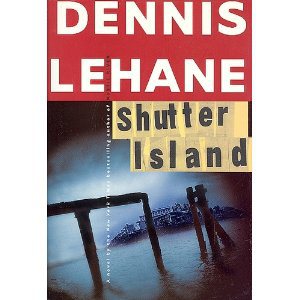
Shutter Island has a twist ending. (no spoilers, I think)

Several of my friends recommended Shutter Island, both the book and the movie. Mysteries aren’t usually my thing, but then this was a departure for them too.

shutter island cover

I immediately liked the two Federal Marshals who went to the titular Shutter island to investigate a runaway. The writing style is engaging, and the dialogue especially is spot-on - it’s so hard to get funny dialogue where you feel it’s the characters being funny and not the author.

However, what begins as an intricate crime/conspiracy investigation becomes something entirely different in the last third of the book. (Note to self: working in a mental institution is not a good career choice for me.) When I reached the last page (with the final twist in the story) I physically threw the book across the room in horror. What did my friends see in it?

I feel like I have a scum of garbage water on my soul.

In conclusion, don’t read this book. I haven’t seen the movie (and, obviously, don’t plan to), but I feel confident in recommending you avoid it, too. Yikes. Continue reading

Pattern Recognition

It’s been a while since William Gibson‘s Pattern Recognition came out, and I still haven’t managed to read it. I enjoyed Neuromancer very much, but haven’t been impressed by some of his other work.

Nevertheless, this interview in the Blackbird Archive is fantastic. Most of it, you’ll notice, is an extended meditation on what constitutes Science Fiction. This is important. I know I can’t give a real answer as to why it is- many more eloquent than me have tried. But I get so tired of the dismissive, “oh, I don’t read scifi.”

There is an extraordinary body of work that satisfies all the requirements of science fiction but is not marketed as such. The Time Traveler’s Wife is about a time traveler, for example, but it’s still in the Contemporary Lit section so everyone reads it. Likewise Gregory MacGuire‘s fairytale re-imaginings like Wicked would be perfectly at home in the scifi section - you wouldn’t even have to change the covers. Hundreds of CIA and crime thrillers deal with future weapons and genetic engineering and spy technology - but they have lots of guns, so that’s okay.

But more than the tropes listed above, science fiction is a way of thinking.

As the review says;

The next matter to be settled is genre. William Gibson is a science fiction writer, so is this science fiction? The answer is yes and no. Unlike Vonnegut, who goes to some pains to say he’s not writing science fiction even when he is, Gibson never shies from the label, even though he’s perfectly aware it’s not so simple a tag as it once was. Pattern Recognition is set in the present with no aliens or secret technologies. The plot turns on nothing more exotic technologically than chat rooms and posted film clips in a very recognizable Internet. Recently, Neal Stephenson’s Cryptomonicon, as fat as Pattern Recognition is lean, was largely treated as a science fiction novel by reviewers, bookdealers, and readers, even nominated for sf awards, though the main action involves the breaking of the Enigma code of World War II and isn’t science fiction in the usual sense. China Mieville’s Perdido Street Station, on another end of the spectrum, seems science fictional even though it takes place in a Dickensian steampunk world with no connection to ours.

Science fiction, in effect, has become a narrative strategy, a way of approaching story, in which not only characters must be invented, but the world and its ways as well, without resorting to magic or the supernatural, where the fantasy folks work. A realist wrestling with the woes of the middle class can leave the world out of it by and large except for an occasional swipe at the shallowness of suburbia. A science fiction writer must invent the world where the story takes place, often from the ground up, a process usually called world-building. In other words, in a science fiction novel, the world itself is a distinctive and crucial character in the plot, without whom the story could not take place, whether it’s the world of Dune or Neuromancer or 1984. The world is the story as much as the story is in the world. Part of Gibson’s point (and Stephenson’s too for that matter) is that we live in a time of such accelerated change and layered realities, that we’re all in that boat, like it or not. A novel set in the “real world” now has to answer the question, “Which one?”

Via Science Fictional. That post also has a link to this interview with William Gibson, equally interesting.