Banned Books Week

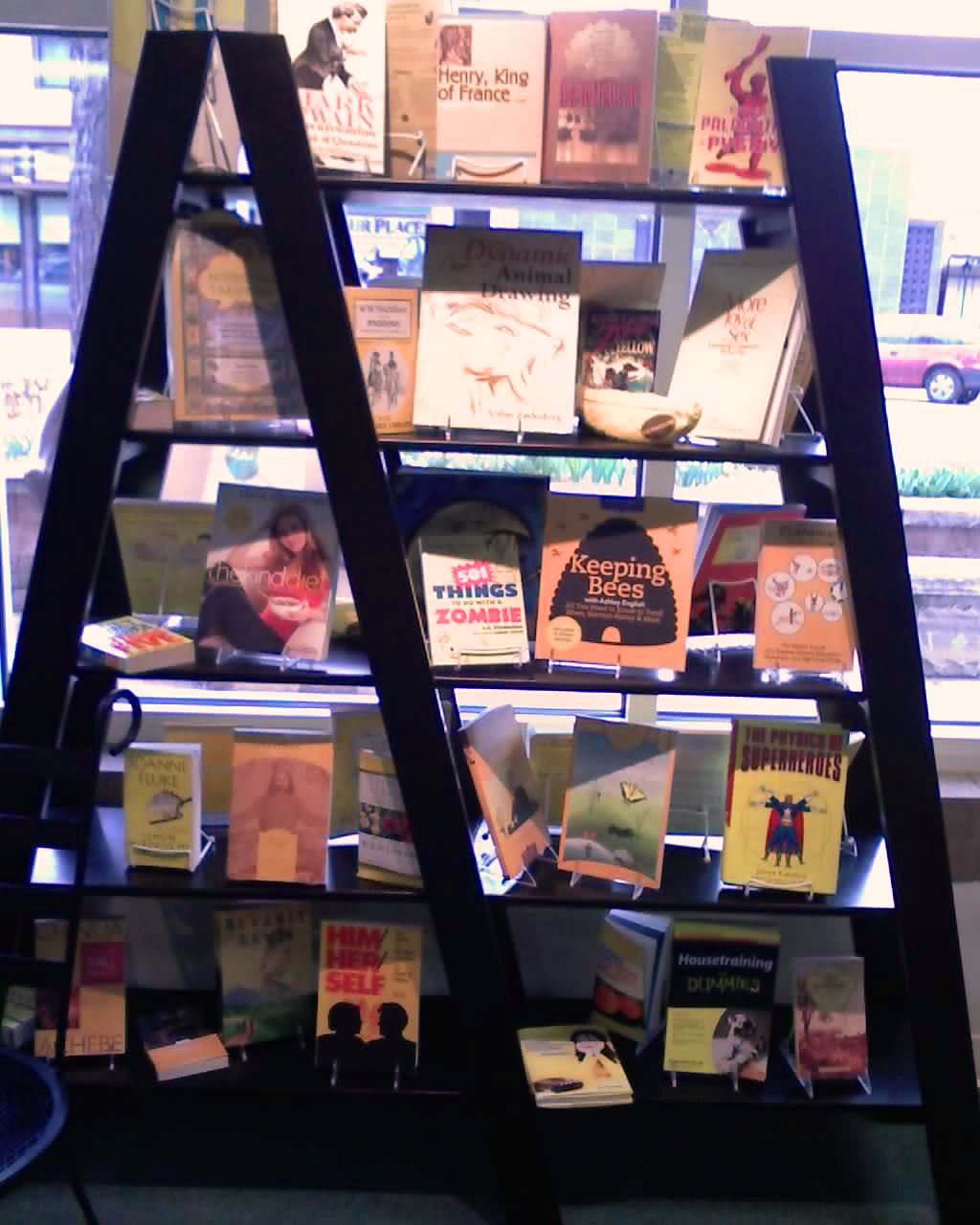
Independent bookstores fight for your right to access the books that you want to read, whatever the content may be. We have a display up right now showcasing over a hundred books documented as banned or challenged - we carry them, and are fiercely proud to defend them. The American Booksellers Foundation for Free Expression collects tools and information to help

In the United States, “banned books” are not illegal to print and sell. However, they are challenged and sometimes removed from libraries, including school, prison, military base, and public libraries. You are entitled to dislike a book, but when a book is removed from a library, you are restricting your fellow citizens’ access to information.

Many sites provide lists of banned books without citing any sources or giving any history at all. This report from the American Library Association provides a list of documented challenges in the US for 2009-2010, and this resource page is an authoritative resource for documented challenges. However, surveys indicate that 85% of challenges are never reported to the ALA.

Here is a map of documented book bans and challenges in the US for the last four years, including three here in Colorado:

“The rights and protections of the First Amendment include children as well as adults. While parents have the right — and the responsibility — to guide their own children’s reading, that right does not extend to other people’s children. Similarly, each adult has the right to choose their own reading materials, along with the responsibility to acknowledge and respect the right of others to do the same.

When we speak up to protect the right to read, we not only defend our individual right to free expression, we demonstrate tolerance and respect for opposing points of view. And when we take action to preserve our precious freedoms, we become participants in the ongoing evolution of our democratic society.”

- Robert P. Doyle, ALA Banned Books Report 2010

August Scifi Book Club Discussion

This past Tuesday, August 4th, the Scifi Book Club met to discuss The High Crusade by Poul Anderson, first published in 1959. Our next meeting will be September 6th, for Who Fears Death by Nnedi Okafor. Both of these books are in the store right now for 20% off!

The edition of The High Crusade that we carry in the story is the 50th Anniversary Edition, which includes an introduction and five “appreciations” from big-name scifi authors. Poul Anderson was hugely influential in the Golden Age. He was extraordinarily prolific, with over 100 novels and enough short stories to fill 40 collections, and this is one of his most beloved books.

Just as King George’s knights are mustering up for another crusade, a spaceship lands in their village. Since they’re all soldiers anyway, they ruthlessly attack the disembarking aliens and kill all but one of them. (A couple of laser pistols are ineffective against a mass volley of English longbows and a line of charging cavalry.) Through a mix of (mis?)fortune, leadership, and pure bald-faced guile, the English take their Crusade to the stars, conquering and converting the aliens as they go. I was amused to discover that Anderson was a founding member of the Society for Creative Anachronism.

It’s very short, under 200 pages, which keeps the story taut and the action quick. It reminded several people of a movie script. (It was apparently made into a movie in the 90s but none of us had seen it.) There are few digressions, which is rare in a funny book. For example, a few months ago we read Shades of Grey, which is full of quirky little sidebars that provide a lot of the humor. Here, there is some physical humor and a lot of sly maneuvering around the truth when talking to the aliens. My favorite bit: the alien wants to know if Sir Roger has the authority to bargain with them. Sir Roger replies, “my ancestor Noah was the commander of all the fleets of Earth.” Several of our members found the humor very British, “almost pre-Monty Python.” Given the appreciations included in the front of the book, we wondered if this book directly influenced writers like Douglas Adams and the Monty Python people, too.

Anderson keeps the tone light by glossing over the deeper aspects of his satire. Instead of conquering tan people and brown people, Sir Roger conquers blue people (and people who live in a box because they breathe a different atmosphere). When they board the ship, the English bring along the entire village, complete with livestock- so when they defeat the aliens, they actually establish a colony on the newly-deserted planet. There is a debate about whether the blue aliens have a soul, and whether they can be converted and baptized.

All of these potentially serious issues are played for laughs. For example, the cattle in the ship make a horrifying stench, and the English cook over an open fire in the hold. Since the aliens have superior force and technology, the English are the underdogs and thus totally justified in tricking and double-crossing the (remarkably naïve) aliens to win. The chapters are very short, and just one or two chapters from an alien perspective could have given the whole thing more depth. To me, it almost reads as though an early draft might have included something like that, but Anderson (or his editor) said, “whatever, our audience is 12-year-old boys, they don’t care, take it out.” As a result, we get this quick, funny reversal of the usual historical narrative – white English dudes are the underdogs, with inferior technology, trying to stay afloat in a much more “advanced” civilization. It remains an open question whether the casually imperialist attitude is simply the usual Golden Age chauvinism or that attitude it is itself being satirized.


The consensus view in our discussion was that the absence of explicit judgments was the very thing that made the book so good. If you want to do a lot of analysis, the material is available there in the story. But, because the issues are only implied, the book remains a quick, fun read. Most of our members said they probably wouldn’t re-read The High Crusade, but it did make some of us interested in Anderson’s larger body of work. I for one intend to read a couple of his other novels for comparison’s sake.

Bechdel Test results: Fail. There is exactly one woman in this story, unless you count her two-year-old daughter. There is an alien character from a race that doesn’t have different sexes, but the aliens are referred to as “he.” Both the woman and the alien are portrayed as weak, conniving, and, in the end, traitorous. This is disappointing, but not surprising in a scifi work from the 1950s.

Events & Book Clubs for July

We’ve got a lot going on in July!

3rd & 4th - We are closed for Independence Day

5th - 6:30pm - Paul Kendel’s book signing for Walking the Tiger’s Path (Scifi book club rescheduled for July 12th)

8th - 6-8pm - Loveland 365 autograph party for Night on the Town

12th - 6pm - Scifi book club (reading The Company by K. J. Parker)

20th - 6pm - Anthology Reader’s Circle (reading One Day by David Nicholls)


Jessica’s Fake Classes

The new topic is Genghis Khan (Chinggis Khan) and the Mongols. Read any book you want about Genghis Khan and/or Mongolian history, and join us this Sunday, May 15, at 5:15 to discuss it.

My “Serious Book Club” idea has morphed into what I’m calling my Fake Classes - designed for those of us without the time and money to go to real classes. (This is not currently an official Anthology club with book discounts, etc.; I’m just using our space to host. Starting in June, meetings may be held in my house instead.)

The idea is that we will meet roughly every other week to discuss a mutually interesting topic. In the spirit of a class rather than a book club, we will meet more than once on each topic to give us a chance to digest and do further research based on our discussions. I’m not picky, really - if you can’t find a book that speaks to you, feel free to read some relevant Wikipedia articles. The Loveland Library has a pretty good selection, though.

The store closes at 5pm, so if you want to buy books or coffee before we start, make sure to come a little early. As with all after-hours book clubs, the side door will be left open so you can get in.

Scifi book club recap: Shades of Grey by Jasper Fforde

First, an announcement: for June only, the Scifi book club meeting will be at 6pm on the SECOND Tuesday, June 14, instead of the normal first Tuesday. We will be reading The Mysteries of Udolpho, which is the book that Jane Austen parodied in Northanger Abbey, and was also one of Edgar Allen Poe’s major inspirations.

So, Shades of Grey. This was our favorite book so far, with an average score over 8.5/10. Unfortunately, this was also our only book so far that no one finished by the meeting - one person got within 30 pages and just didn’t quite squeak by the deadline. Despite that, we were all pleased with the intricacy of Fforde’s world and the humor woven into the story. I finished it on Wednesday, and the plot really picks up in the second half of the book. Eddie starts seriously investigating the weird happenings in the village, and, by extension, the mysteries underlying his world.

In the far future of Shades of Grey, hundreds of years after the Something That Happened, society is rigidly segregated based on acuteness of color perception. Order is rigorously maintained by adhering to the Rules of Munsell, an extraordinarily thorough collection of edicts governing almost every aspect of life. For example, the Rules specifying which articles may be manufactured left spoons off the list, so spoons are valued heirlooms, passed down through generations and jealously hoarded. Loopholery is a respected art and the only method of getting anything done. Also, most damagingly, there are periodic Leapbacks and DeFactings, reducing the level of technology and the amount of knowledge available each time. The most recent Leapback removed mechanical tractors, zippers, and yoyos, among other things, leaving people dependent on trains and Model Ts for transportation. It is, in many ways, a dismal place to live.

Although the book is indeed very funny - I even literally laughed out loud a few times - the best part is that almost none of it is funny to the characters. Fforde walks a delicate balance of pathos and lightheartedness. The situation of the characters and the world itself is deeply sad, but due to the fact that they are inside the world, the characters have no perspective to compare the world to anything else. Except one: the female protagonist, Jane.

Jane’s setup reminded me very much of Scott Pilgrim vs. the World. She busts into the normal, boring world of our loser protagonist, Eddie Russett, and, by being surly and uninterested in him, causes him to fall in love with her (and her extremely retroussé nose.) In a novel all about the metaphor of vision, she is the one person with perspective. It makes her violently angry, all the time, often in situations where it would benefit her to just keep her head down. As her character develops, her anger and lack of self-control reminded us of the protagonist from The Darkship Thieves, which we read earlier in the year. Jane ends up more interesting and sympathetic than either Ramona of Scott Pilgrim or the protagonist of The Darkship Thieves, because “a quirky working-class girl fighting the Establishment” is much more fun than either “a quirky emo girl whining about her life” or “a rich heiress fighting the establishment”.

If you’ve read any of my reviews before, you’ve likely noticed that I’m always keeping a running tab in my head of the Bechdel test - 1) are there two named female characters, 2) who talk to each other, 3) about something other than a guy? This book has lots of female characters, and a pleasing number of them are in positions of authority. It meets the conversational criteria in a couple of places - but every female character is a total bitch. There are Society matrons scheming for arranged marriages and committee politics, female cops with no compassion or concept of bending the rules, young women using sex as leverage and double-crossing their lovers at every turn. Granted, most of the guys are jerks, too.

The only exceptions to the “every major character is a jerk” trope are Eddie and his dad, the Librarians, and the Apocryphal Man, who is (or was) a historian. A few technicians also seem pretty okay - maintenance workers and so on. The symbolic representatives of knowledge are sympathetic characters, many working underground to share their knowledge, whether it’s Morse code bedtime stories or questions answered in exchange for Loganberry Jam. Except for Jane, who is the omega bitch, and the ambiguously moral but always polite Color Man.

Shades of Grey touches on such a wide range of subjects that we found ourselves circling back to it naturally no matter how far off-topic we wandered. For example, there is a throwaway joke about retail sales - “buy one get one free” vs. “half off”. What would you rather have, something for half price or something for free? One character, Tommo, speculates that there used to be a whole science of selling, which they, of course, have lost. Eddie’s hobby is advanced queuing systems; in this world, “take a number” counts as a radical new idea. But when they discuss their ideas, each greets the other’s with disinterest and/or skepticism.

There were many parallels with Lois Lowry’s The Giver. A society removes color perception from the general population as part of a system to suppress individuality and conflict. Those with color perception are singled out for special privileges but also isolated from the rest of the community. Planned life stages result in strictly controlled birth rates and euthanasia in old age. There were even specific moments of congruence, such as the protagonists both seeing red hair on their girlfriends. It’s like Fforde read The Giver and decided it would be a much better book if it were funny. (He may be right.)

One caveat - on literally the last page of the book, Eddie is forced to make an ambiguous moral choice. While I don’t object to the principle, it’s a seriously contrived, last-minute, deus ex machina sort of problem manufactured to lend a sense of urgency to the forthcoming sequels. Personally, I have decided the incident simply didn’t happen, and the book ended two pages earlier.

Shades of Grey comes highly recommended, and we still have a couple of copies in the store at 20% off – grab one while we’ve got them. :)

Featured books!