The Empathic Civilization

The Empathic Civilization


I just finished a most extraordinary book. The Empathic Civilization, by Jeremy Rifkin is a new interpretation of the history of civilization, how we got to where we are now, and what we can do to ensure the highest probability of survival of our species. Jeremy Rifkin is one of the most popular social thinkers of our time. He is an adviser to the European Union and other heads of state around the world. He is also the president of the Foundation on Economic Trends in Washington, D.C.

Rifkin’s main argument in The Empathic Civilization is that empathy has played a larger role than previously thought in the formation of civilization. He argues that empathy has profoundly affected major shifts in human consciousness throughout human history and will likely be the determining factor of whether or not we survive as a species. Never before have we been so connected through technology and commerce, yet so torn apart by war, climate change, hunger and disease. Our human made environment is transforming the world, yet our existing modes of consciousness are from earlier eras of human history.

According to Rifkin, the ability to empathize is fundamental to human nature. He insists that it is time to rethink our earlier assumptions that human beings are naturally self-centered and materialistic, as the Enlightenment philosophers hundreds of years ago claimed. Recent discoveries in brain science and child development are forcing us to re-examine the old ideas of attaining happiness through unlimited material progress. Biologists are discovering mirror neurons, also known as empathy neurons, that allow human beings to feel and experience another’s situation as if it were their own. Empathy has been the driving force behind the evolution of individuals and of civilizations as a whole. Social scientists are discovering the evolution is measured not only by the expansion of power over nature, but also by the intensification and extension of empathy to more diverse range of people.

Rifkin argues that the core of the human story is the paradoxical relationship of empathy versus entropy. Entropy is the process of a system in degeneration. So, the paradox is this: our ever increasing technological complexity brings more diverse people together, which in turn heightens empathic sensitivity and expands human consciousness, but the growth of our empathic awareness is only possible because of an ever greater consumption of the Earth’s energy and resources resulting in a dramatic deterioration of the health of the planet. Empathy is at its highest point in recorded history. Entropy is also at its highest point in recorded history.


Rifkin advocates what he calls “the 3rd Industrial Revolution”. The 1st Industrial Revolution was enabled through steam power, the 2nd through coal. The 3rd Industrial Revolution, also known as the era of Distributed Capitalism, is comprised of four parts. The first is that we must switch to renewable energy. It’s free and it’s everywhere on the planet to some degree. The second is that we should turn every home, business and automobile into its own power generator. Rifkin calls these “buildings as power plants.” By attaching solar panels and utilizing other renewable energies, we can have every single building create all of its own energy. The third aspect is that we must have a way to store this energy for future use. Through the use of hydrogen cells, we can store renewable energy that is captured. The fourth and most important aspect of the revolution is that we need to be able to sell and share surplus energy with others through existing electrical and internet grids. The rise of open source sharing of energy, like open source sharing of information, will usher in collaborative energy spaces, much like the collaborative social spaces that already exist on the internet. When every family and business becomes responsible for its own energy creation and consumption by harnessing renewable energy sources and sharing it with others through smart inter-continental power grids, we will become more intimately connected by our most basic of need: energy.

We currently possess all of the knowledge and technical expertise to carry out these fundamental changes, but can we do it in time to avert global catastrophe? It’s no longer even debatable that our activities and lifestyles as humans are unsustainable and contributing to global climate change and threatening our very existence. We have no choice but to change.

The transition to biosphere consciousness has already begun. All over the world, a younger generation is beginning to realize that one’s daily consumption of energy and other resources ultimately affects the lives of every other human being and every other creature that inhabits the Earth.

We are on the cusp of global peak empathy. We are also on or possibly past the point of global peak oil. Our intensely interconnected world is on the verge of what Rifkin calls “biosphere consciousness.” To resolve the empathy / entropy paradox is the critical test of our species’ ability to survive and flourish. Whenever a new energy regime has converged with a new communications revolution, society is pushed toward further complexity. This time around is critical though, we may not have ample time to change. The Empathic Civilization is emerging, but will it happen fast enough to avert global catastrophe?


Thanks for reading!

Matt
Literature or Fiction?

Working at Anthology, I commonly get asked what the difference is between literature and fiction and why we seperate the books the way we do. Besides the obvious size difference in the mass market and the trade size books, there are other reasons to differentiate between literature and fiction. The way I understand it is that literature is a work of lasting cultural significance or a novel that deals with universal themes. Literature, as opposed to fiction, tends to illuminate certain aspects of the human condition and also focus on writing style and character depth. Fiction can be described as a novel that has a specific audience and can be sub-divided into genres such as romance, science fiction, westerns, mystery, thriller, etc. Fiction (or genre fiction) tends to focus on plot and narrative instead of writing style. Of course, any book in one of these categories could cross-over into the literature category as well, and vice versa. Literature is not limited to the novel. Writings on history, poetry, philosophy, and science are also traditionally classified as literature, but here at Anthology, we keep our literature section specific to novels for the sake of simplicity. So, there is really no cut and dry method of determining what is considered literature and the methods of deciding the distinction are many.

I hope that makes it a little less confusing for our readers.

Thanks for reading!

Matt

11/22/63

I keep thinking about time travel. What if I could travel back in time? What would I change, if anything? Considering the butterfly effect, even the most minute differences in past actions could have a drastic effect on the future.

The more I think about it, the more I am convinced that all of the small occurances within one’s life build and build to create our current reality. Any small change could send somebody’s life, or all of history, veering off into another direction.

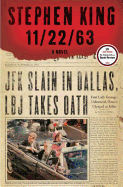
This is the premise of Stephen King’s newest novel 11/22/63. Any fan of Stephen King will know right away that this isn’t his typical type of story, although, also typically King, it is extremely imaginative.

It’s 2012, and recently divorced highschool teacher Jake Epping is just going through the motions, trying to make life work for him. All of that changes one day when he discovers what he calls a “rabbit hole” where he can travel back in time to a specific date and place in 1959. While thinking about what past event he could change to have the maximum beneficial impact on future life, he comes to the decision that he must prevent John F. Kennedy from being assassinated.

The portal allows for whoever is using it to re-enter it and return to the present, although if you enter the “rabbit hole” again and travel back to 1959, then the whole thing re-sets, and whatever you have changed in the past is no longer affecting the future (or so it seems). So Jake’s mission to prevent the Kennedy assassination comes down to him finding and killing (or stopping) Lee Harvey Oswald from pulling the trigger. But what if the conspiracy theorists are right and Oswald was set-up and really had nothing to do with the assassination? Jake has to make sure he’s got the right man before he acts.

And so begins the adventure’s of Jake Epping (now George Amberson, to be on the safe side) in what he calls the “Land of Ago”. The momentum builds to a breathtaking climax as Jake struggles against the obdurate past to alter history for the better

11/22/63 is an immensely enjoyable and believable story. With a thorough knowledge of American culture in the 1960’s, King takes us back to a time before internet and cell phones, where doctor’s smoke cigarettes and racial bigotry still ruled much of the land. This brilliant story ends with a mind bending twist that will keep you awake at night wondering what you would change if you could go back and do it all over again.

Thanks for reading!

Matt

Soul of a Citizen

In our troubled times on planet Earth, it’s sometimes easy to fall prey to cynicism or apathy. We seem to be bombarded by problem after problem and our news outlets seem to relish any opportunity to share a negative story. But not all hope is lost. Paul Rogat Loeb’s “Soul of a Citizen” (ISBN 9780312595371) is an extraordinarily inspiring and moving work focusing on how anybody can become involved in social activism in an attempt to change our world in big and small ways for the better. Loeb is obviously very passionate in educating others about citizen involvement in issues that should be important to all of us. Through numerous stories and examples of ordinary people who saw something wrong and worked up the courage to gather support and bring people together to make a positive difference. Whether we are concerned over environmental issues, human rights campaigns or stopping needless wars, “Soul of a Citizen” could be just the encouragement that we need to take action on our most deeply held beliefs. Loeb explores what leads people to become involved in social activism, the pitfalls that could discourage budding activists and ways to remain optimistic and hopeful for the long haul in the face of overwhelming opposition. “Soul of a Citizen” clearly illustrates that the only people who have ever made a difference were ordinary citizens who became involved, sometimes reluctantly, in issues close to their hearts. All movements of great change must start small and progress step by little step.

Many people are dissuaded from becoming involved in issues important to them because they feel that they must know every detail about the problems and proposed solutions. Loeb calls this “the perfect standard” and argues that we don’t need to know everything about a certain injustice to feel in our hearts that something needs to be done, and to act on these feelings. We can all start where we are, and take things a little at a time. By building a supportive group or community of like-minded individuals, we have the potential to accomplish far more than if we acted alone. Loeb offers encouragement to help enlist the uninvolved to your cause. Many people know about issues such as environmental injustice, but without being engaged, are unlikely to make their voice heard. Even small actions can ripple outwards and have unpredictable effects on the world around us.

“Soul of a Citizen” has inspired countless citizens to act on their most deeply held morals and beliefs. The original edition published a decade ago has become a classic handbook in the field of social activism. The updated edition published in 2010, is brimming with even more inspiring stories and engaging advice to help us meet the challenges of our difficult times. “Soul of a Citizen” offers a powerful and hopeful cure for the cynicism that plagues our world.

Thanks for reading!

Matt

Shantaram

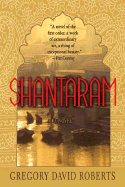
India. Bombay. A place I’ve never been, but felt like I have spent a lifetime. Gregory David Roberts’ “Shantaram” (ISBN 9780312330538) is such an exceptionally descriptive and beautifully lyrical novel that it transports the reader to a different time and place, and a different life. The scenes of the daily life and people of 1980’s India are so poetically and colorfully conceived, one can’t help but fall in love with the place.

“Shantaram”, which is Robert’s first novel, is autobiographical and mostly (if not entirely) based on Robert’s own life and adventures. The story begins when the freshly escaped convict, Lindsay (the name on Roberts’ counterfeit passport), arrives in Bombay after his heroic escape from a 20 year sentence at a maximum security prison in Australia. Promptly after his arrival, he is befriended by a local guide who agrees to show him around the city and gives him the nickname Lin. Lin soon finds out how easy it is to make money on the black market making deals with other foreigners. He quickly learns the languages Hindi, Marathi and Urdu, and finds himself invited to live in the slums with his guide and friend. When the slum dwellers find out that he has some medical skills from his heroin addiction days, they start lining up at his hut every morning to receive medical attention, which Lin is more than happy to administer for free. He achieves hero status with the locals and falls in love with the slum. After that, things take a drastic change and events in Lin’s life don’t transpire so smoothly.

Lin finds himself attracted to the life of crime that got him imprisoned in the first place and inadvertently joins the Bombay mafia. Lin’s wild and adventurous nature drives him to engage in a plethora of dangerous endeavors. From street fights to opium dens, counterfeiting and smuggling, working and acting for Bollywood films, fighting in a holy war and keeping company with an array of prostitutes, drug users, gang members, slum dwellers and black market workers, Lin leads us on one hell of an adventure. With all that Roberts has survived it is truly amazing that he is even alive to write his story at all.

“Shantaram” is such a thrilling story of freedom and friendship, cruelty and hope, love and loss that I found it almost impossible to put down. Ultimately, “Shantaram” is a story of redemption. The redemption of a man losing himself and everything he loves, creating a new life, only to lose it all again and find what truly is important in life. Despite its massive 936 page size, I cherished every second of it. To make the story even more intriguing, we find that “Shantaram” was written in prison after Roberts’ final recapture to serve out his original sentence. The first two drafts of the novel were destroyed in prison, so Roberts really wrote “Shantaram” three times!

Vividly descriptive and elegantly formed, “Shantaram” is a truly epic story that I feel like I lived out myself. Roberts’ life is filled with so much excitement that this book is sure to make your own life seem boring and mundane. Utterly heartbreaking and courageous, every chapter ends on such a splendid note, that I found myself rereading the last few paragraphs of each one, absorbing each word of wisdom This is a novel that is so rich, textured and unforgettable that it has definitely found itself onto my list of all time favorites. Anyone who loves a grand sprawling epic of a read, filled with truth and humor, love and betrayal, wisdom and adventure is assured to come out of this one touched, changed and completely satisfied.

Thanks for reading!

Matt

Here’s a link to Roberts’ website where he shares facts about his life and philosophy, shares pictures and keeps us updated on the status of the sequel to “Shantaram” and the (hopefully) soon to be movie. http://www.shantaram.com

Conscious Evolution

Conscious Evolution

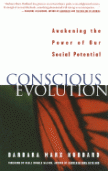
Few people today can deny that we are at an extremely critical juncture in human history. We have the scientific and technological capabilities to destroy or enhance our life support system on earth. When Barbara Marx Hubbard wrote “Conscious Evolution” (ISBN 9781577310167) 14 years ago, it was an urgent call to action to change our self destructive patterns. Her message is even more relevant today as our habits of environmental destruction, war, and overpopulation are reaching a perilous climax.

I was intrigued about Barbara Marx Hubbard and her work as a futurist after seeing the recent movie “Thrive” in which she was featured during an interview. She was also recently featured in Bella Spark magazine discussing her new book “Birth 2012 and Beyond” (ISBN 9780984840700) which will be released on May 1, 2012.

Most people have heard of the human potential movement whose advocates adhere to the concept that in all humans lie an untapped and extraordinary potential for individual creative greatness. Hubbard’s work is aimed toward expanding that movement toward more of a social potential movement. The idea is that when we find ways to co-create with others then our collective potential is exponentially expanded. “Conscious Evolution” attempts to lay down a blue-print for a co-creative society that enhances and connects social innovations and breakthroughs in an attempt to bring humanity safely through these uncertain times.

One of the most hopeful ideas presented in the book is that in our whole evolutionary history, crisis has always preceded transformation, and it is the nature of nature to transform. With this in mind, we can rest assured that our present systemic and societal breakdowns are a natural evolutionary process. I always like to think of it in terms of labor pains. It’s not a pleasant process and certainly is dangerous, yet something beautiful is being born. We are at a point where we can consciously guide our own evolution. We know now that we affect our evolution by every thing we do; collectively and individually. Never before in human history have we had the capacities and knowledge to understand our own evolutionary process. We can now cooperate with these processes instead of fighting against them.

With the advent of the internet, our interconnectivity is at an unprecedented level, and growing. Great ideas can be shared almost instantaneously, advancing humankind in all aspects. Sharing what works and what still needs to be done in the sectors of science and technology, education, justice, health, spirituality, infrastructure, environment, media, governance, relations, arts and economics, can further enhance positive changes and discard old systems that no longer work for us. Fortunately the internet, cell phones and social media make this possible.

Hubbard uses the analogy of a caterpillar morphing into a butterfly to illustrate the genetically encoded pattern of our planetary evolution toward a higher consciousness. The collective fate of humanity need not end in an apocalyptic scenario. According to Hubbard, the crises and opportunities for change we face today are normal and part of the inherent pattern in nature.

In “Conscious Evolution” a coherent plan of action is put forth on how to help humanity become more globally minded through integrating spirituality into social policy. At the end of the book there is a detailed (and maybe a little outdated) list of resources, organizations and media outlets who are participating in this change. The book is very accessible and the ideas presented are easily understandable.

Barbara Marx Hubbard is calling for a global awakening. The earth’s first “birthday” as she calls it in her new book “Birth 2012 and Beyond”. A day of mass celebration when we realize that we are going to make it and prosper, can help launch us into a new paradigm. This day, which will be full of scientifically proven methods of meditation and prayer, has the potential for a global heart and mind change to nudge us into a new co-creative society. Hubbard proposes that we use December 22nd 2012 (the day after the end of the Mayan calendar) as earth’s new “birthday”. Many ancient and religious traditions point to this time in history as an era of great change and the start of a new cycle. Hubbard suggests that we have the power to make this happen.

Many organizations and groups of people actively participating can catalyze this change. Imagine a society where everyone’s needs are met, where we can collaborate and co-create with each other, helping each other to find our life’s purpose and fulfill our creative potentials; where conflict is no longer an issue, scarcity is no problem; we would be free to explore space, inner and outer, to our heart’s desire. This is the future where Hubbard’s idea of conscious evolution could help lead us. Through hope, determined effort and cooperation this is possible. I highly recommend this encouraging and inspiring book to everybody who wants to participate in the outcome of humanity. In today’s cynical world, it is desperately needed.

Interested in learning more?

Check out Hubbard’s websites www.birth2012.com and www.evolve.org

or check out Barbara Marx Hubbard’s new book “Birth 2012 and Beyond” set for release in May.

Other recommended resources of organizations incorporating and sharing positive change:

Institute of Noetic Sciences http://www.ions.org

Yes! Magazine http://www.yesmagazine.org

Alternative news http://www.alternet.org

www.avaaz.org

Image

Thanks for reading!

Matt

Book Trading

To all of our wonderful and loyal customers, we will not be accepting any books for trade from now until after the new year (Monday January 2nd, 2012) due to our end of the year inventory count. Thanks for understanding and sorry for any inconvenience!
- Anthology Staff